 Watch enough Bake Off shows and your brain wonders why this country doesn’t offer more food options – 25 brands of the same old pasta sauce or canned soup doesn’t cut it for me anymore. So naturally I decided to make clotted cream, something they’re always dishing out on scones and the like.
Only problem is the traditional method involves time – lots and lots and lots of time. You are only pouring heavy cream into a container and letting it cook in an slow oven (about 175°), but it’s for 10-12 hours and then you end up with what I call scabbed cream, where the top is golden and there’s lots of liquid underneath to pour out before you can cover and refrigerate for another set of hours. Don’t want to hear about how it’s fine to eat the crust – I don’t think it’s particularly appealing, but then maybe you ate scabs as a kid.
So I searched and searched for other ways because, let’s face it, traditional means before the age of modern appliances and do we really want to trade our stand mixers for a set of whisks? Slow cookers, multi cookers, rice cookers – so many ways and yet not what I wanted. In the end I decided to play around with my microwave since there were plenty of those recipes out there, too! Eliminate all the nonsense and this is how it goes down:
Pour heavy cream into a microwave safe container (duh). Traditional recipes say you can’t use ultra-pasturized cream, but that’s BS; traditionally you’d probably also keep a cow in the yard. I poured a quart into the Pyrex container shown.
Originally I had the top covered with a dishtowel to prevent splatter, but tried it without and found that running a few minutes at a time meant no splatter. I used 3 minute increments, stirring in between (careful for intense boiling action here).
Since so much depends on quantity of cream, size of container and power of your microwave, I’ll just say to run the above scenario a few times until the cream starts thickening; eventually you should be able to tell when there’s only a slight jiggle and then it’s done. Remove to cool on the counter (I put a dishtowel on top – cats, you know) and once cool, placed in the refrigerator for a number of hours – shoot for overnight. I put a dishtowel on top and then the Pyrex cover, just to catch any moisture.
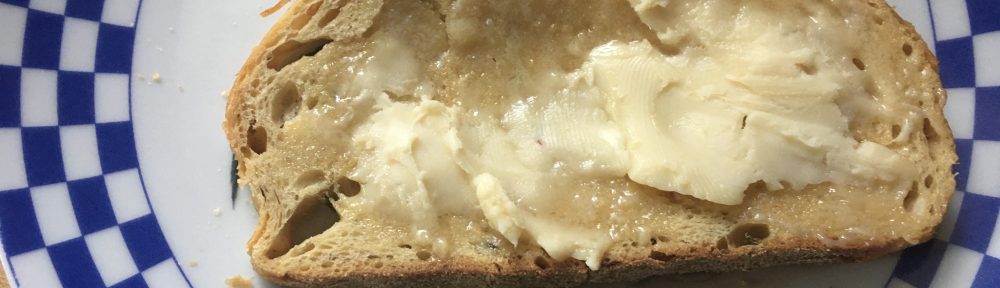
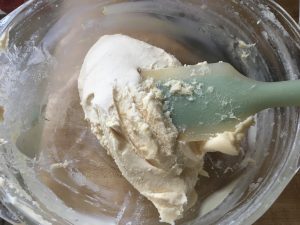
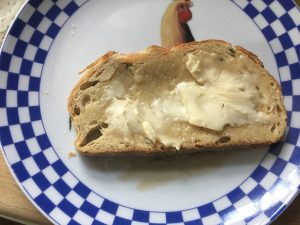
What you’ll end up with is a product that looks and spreads exactly like butter but tastes slightly different. When you make butter you have lots of whey which we’re all told to reserve and save for future baking … har, har. Here any extra liquid must have been nuked away because it’s completely solid and my next step will be to put into a food storage container. This is the bee’s knees, folks and I will definitely be making it again since the higher butterfat content is much closer to European butter.
Had I microwaved it slightly less, I would have had a “looser” product, much closer in consistency to clotted cream, but that’s for my next attempt. This one is very, very good and very, very easy.